No heat or no cooling right now? The emergency line is answered by a person, 24 hours a day, every day of the year. Call 000-000-0000
Most no-heat calls have a cause that is cheap and a symptom that is frightening. A dirty flame sensor will shut a modern furnace down completely and looks, from the thermostat, exactly like a dead appliance. So does a tripped pressure switch, a blocked condensate line or a cracked ignitor worth forty dollars.
Before you call, there are three things worth checking, and we would rather tell you than sell you a visit for them: the thermostat is calling for heat and has fresh batteries, the furnace switch on the wall or joist has not been knocked off, and the service breaker has not tripped. If all three are fine, ring us.
What we are usually looking at
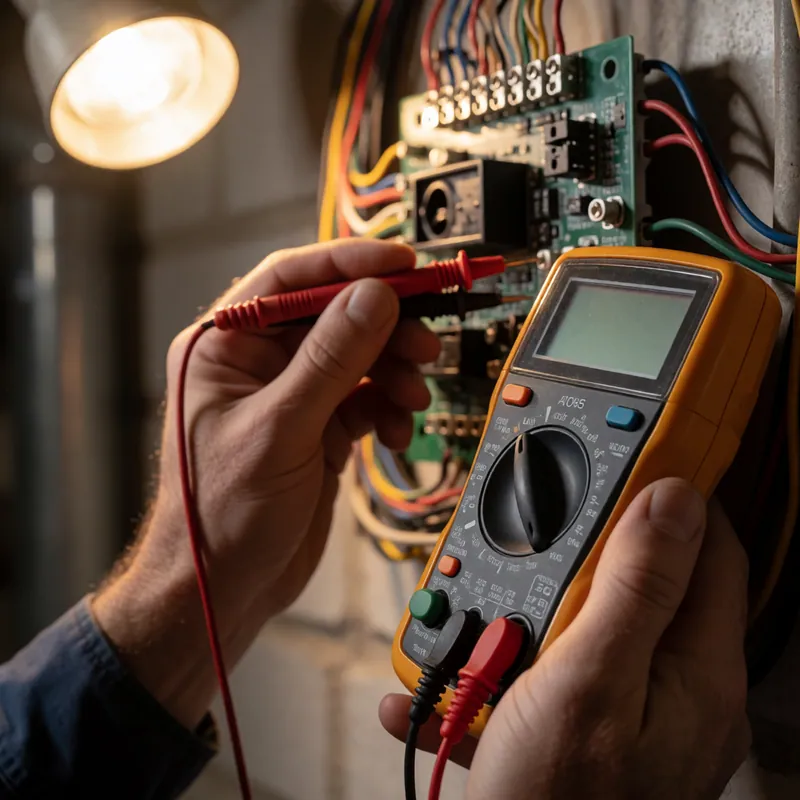
Diagnosed properly with instruments, not swapped part by part until the symptom goes away.
Ignition faults
Cracked hot-surface ignitors, dirty flame sensors, failed spark modules. Between them, the majority of no-heat calls on a modern furnace.
Pressure switch and venting
Blocked intake or exhaust terminations, a bird's nest, a drift of snow, or a condensate trap full enough to stop the draught. The safety is working; something upstream is not.
Blower and motor failures
Failed capacitors, seized bearings, ECM modules. Heat is being made and not delivered.
Control boards and thermostats
Intermittent faults that come and go with temperature, and the low-voltage shorts that follow a do-it-yourself thermostat installation.
Boiler-specific faults
Failed circulators, air-bound loops, low-water cutoffs, waterlogged expansion tanks, and steam systems that hammer.
Gas valves and safeties
Diagnosed and replaced properly. We do not bypass a safety to get a system running overnight.
When to stop and call immediately
Some of this is a repair conversation. Some of it is a leave-the-house conversation, and it matters that the difference is clear.
You smell gas
Do not touch a switch. Leave the building, and call the gas utility's emergency line from outside. Then call us.
A carbon monoxide alarm sounds
Get everyone out and into fresh air, call 911, and do not go back in until it has been cleared. This is not an appliance appointment.
Soot, a yellow lazy flame, or heavy condensation on windows near the furnace
Turn it off and call. These are combustion symptoms and they do not improve on their own.
A burning smell that does not clear after the first burn of the season
Turn it off. Dust burning off is a few minutes; anything longer is not dust.
Keeping the heat in until we get there
If the wait is going to be a few hours in a cold snap, this is what actually helps.
Close off unused rooms
Concentrate what heat there is where people actually are.
Open the cabinet doors under sinks on exterior walls
Especially in a kitchen or bathroom over an unheated space. Frozen pipes turn a bad night into a much worse week.
Leave a tap trickling on the coldest run
Moving water is far harder to freeze than still water.
Do not use the oven or a portable generator for heat
Every winter this kills people in this city. Electric space heaters on their own circuit are fine; combustion appliances indoors are not.
If you smell gas, leave the building and call your gas utility's emergency line from outside — do not operate switches on your way out. If a carbon monoxide alarm sounds, get everyone into fresh air and call 911 first. General guidance on this page is not a substitute for a licensed technician looking at your own equipment.
Questions
Heating Repair — the questions we are asked most
Do you do emergency heating repair at night in Woodside?
Yes. The emergency line runs 24 hours and is answered by a person, not a message service. No-heat calls in freezing weather are dispatched ahead of everything else, and households with young children, elderly residents or a medical need are prioritised within that.
My furnace will not turn on. What should I check first?
Three things: the thermostat is set to heat, calling, and has fresh batteries; the furnace switch — it looks like a light switch on the unit or a nearby joist — is on; and the breaker has not tripped. If all three are fine, it is a service call and we would rather come out than have you take a panel off.
How much does a furnace repair cost?
Most repairs fall between $195 and $700. The $119 diagnostic is credited in full against any repair you approve on the same visit. The most common winter fault — a dirty or failed flame sensor — is at the bottom of that range.
Why does my furnace start and then shut off after a minute?
Classic flame-sensing failure: the burner lights, the control cannot confirm flame, and it shuts the gas off as designed. Usually a dirty sensor and a cheap fix. It can also be a blocked flue or a condensate backup, both of which are safeties working correctly.
My radiators are banging. Is that dangerous?
Steam hammer is usually condensate trapped where steam wants to travel — a radiator pitched the wrong way, a failed vent, or a sagging return. It is hard on the pipework and worth fixing, and it is almost always cheaper than it sounds.
Is there an extra charge for a night or weekend call?
There is a $189 after-hours call-out, waived for Total Care plan holders. The repair itself is charged at the same flat rate whatever time we arrive.
Related
Often needed alongside this
Heating
Furnace Installation
High-efficiency gas furnaces sized, installed, vented and commissioned properly — with combustion analysis, not just a flame you can see.
Read more
Heating
Boilers & Steam Heat
Steam and hot-water boilers, radiators and the century-old distribution that heats half of this neighbourhood — serviced by people who understand it.
Read more
Heating
Water Heaters
Tank and tankless water heaters installed, repaired and replaced — including the orphaned-flue problem a furnace upgrade leaves behind.
Read moreSame-day service in most cases
Book a visit, or call the 24-hour line
Tell us what the system is doing and we will tell you honestly whether it needs somebody tonight or whether it will keep until the morning. Diagnostics are $119 and credited in full against any repair you approve.